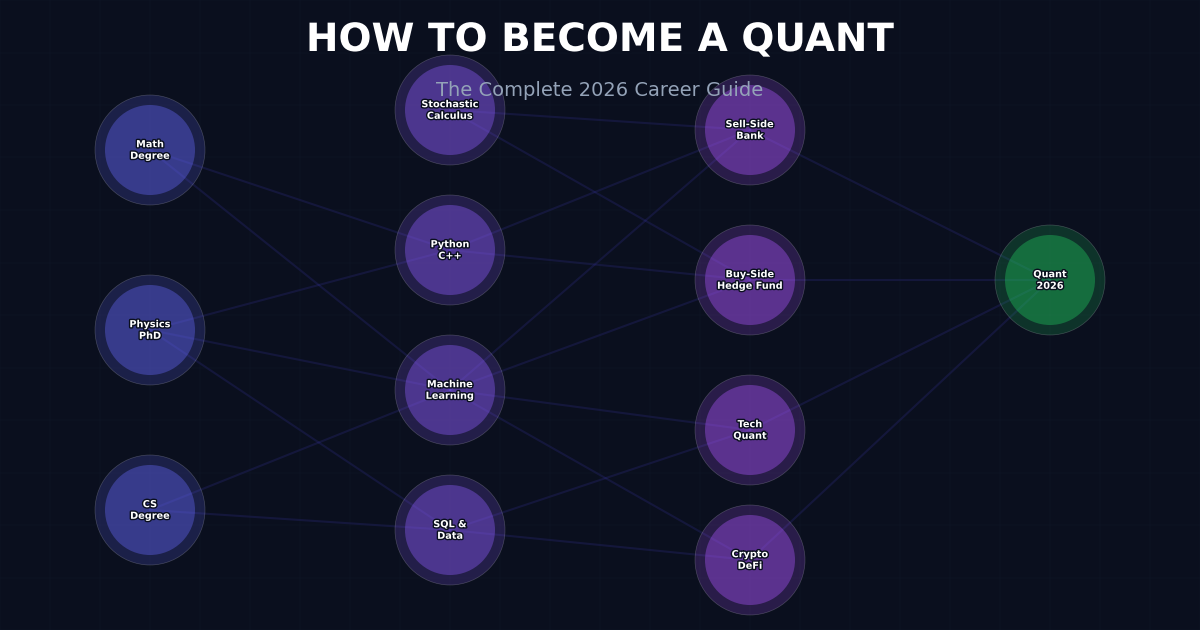
How to Become a Quant in 2026: The Complete Career Guide
Published by Amit Kumar Jha • Desk2Quant • July 2026
The quantitative finance landscape has shifted dramatically in the past two years. AI models now write pricing code, LLMs summarize research papers in seconds, and yet the demand for human quants has never been higher. Why? Because the job has evolved—and the people who understand why models fail, not just how to run them, are the ones banks and funds are fighting to hire.
This guide is not a generic "study math and learn Python" listicle. It's a 2026-specific roadmap based on what hiring managers at Goldman Sachs, Citadel, Two Sigma, and Jane Street are actually looking for right now.
What Does a Quant Actually Do in 2026?
The term "quant" covers a spectrum of roles. In 2026, the landscape has crystallized into four distinct tracks:
| Role | What You Do | Where | 2026 Trend |
|---|---|---|---|
| Front Office Quant | Pricing exotic derivatives, building vol surfaces, real-time risk | Banks (GS, JPM, Barclays) | More Python, less Excel. AAD (Adjoint Algorithmic Differentiation) now standard. |
| Quant Researcher | Alpha research, signal generation, statistical arbitrage | Hedge Funds (Citadel, Two Sigma, DE Shaw) | ML-heavy. Alternative data (satellite, NLP) now table stakes. |
| Quant Developer | Low-latency systems, pricing libraries, risk infrastructure | Banks + Prop Shops (Optiver, IMC, HRT) | C++ still king for HFT. Python for everything else. Rust gaining traction. |
| Risk/Model Validation Quant | Model validation, VaR/ES, stress testing, regulatory compliance | Banks, Regulators (Fed, PRA, ECB) | FRTB implementation driving hiring. XVA desks expanding. |
Key insight for 2026: The lines between these roles are blurring. A front office quant now needs to write production Python, a quant researcher needs to understand market microstructure, and a quant developer needs stochastic calculus intuition. Generalists with depth are winning over narrow specialists.
The 2026 Skill Stack: What Hiring Managers Actually Want
1. Mathematics (Non-Negotiable)
You don't need a PhD in pure math, but you need working fluency in:
- Probability & Statistics — Conditional expectation, Bayesian inference, hypothesis testing, copulas, extreme value theory. This is 60% of what you use daily.
- Stochastic Calculus — Ito's Lemma, Girsanov's theorem, martingale pricing. You need to understand it, not just memorize formulas. Can you explain why we change measure from $\mathbb{P}$ to $\mathbb{Q}$ in one sentence?
- Linear Algebra — PCA for risk decomposition, eigenvalues for covariance estimation, matrix calculus for ML models.
- Numerical Methods — Monte Carlo (variance reduction), PDE solvers (Crank-Nicolson), optimization (Levenberg-Marquardt, differential evolution).
2026 shift: Pure math knowledge is now a prerequisite, not a differentiator. What separates candidates is the ability to connect math to market reality—knowing when models break and why.
2. Programming (The New Filter)
In 2026, programming is the #1 filter in quant interviews. Here's the hierarchy:
| Language | Where It's Used | Interview Weight |
|---|---|---|
| Python | Research, prototyping, ML pipelines, data analysis | 50% of coding interviews |
| C++ | HFT, pricing libraries, risk engines | 30% (higher for dev roles) |
| SQL | Data extraction, trade blotter queries, risk reports | 15% (often overlooked, easy to prep) |
| R / Rust | R: legacy risk systems. Rust: next-gen HFT. | 5% (nice to have) |
2026 shift: Python is now expected at every level. Five years ago, a quant could get away with "I know Excel VBA." Today, if you can't write a Monte Carlo pricer from scratch in Python, you're not getting past the first round.
3. Financial Knowledge (The Differentiator)
Math and code get you the interview. Financial knowledge gets you the offer. Focus on:
- Derivatives Pricing — Black-Scholes, Greeks, vol surfaces, local vs stochastic vol, exotic payoffs. Can you explain a variance swap to a trader?
- Risk Management — VaR, Expected Shortfall, CVA/DVA/FVA, SA-CCR, FRTB. These are the regulatory frameworks driving bank hiring in 2026.
- Market Microstructure — Order books, bid-ask spreads, market impact, adverse selection. Critical for buy-side roles.
- XVA — Credit Valuation Adjustment, Debt Valuation Adjustment, Funding Valuation Adjustment. XVA desks are one of the largest quant employers.
The Education Paths: Degree vs Self-Study vs Bootcamp
Path 1: Traditional Degree (Still the Gold Standard)
The top feeder programs in 2026:
- Mathematical Finance / Financial Engineering — Carnegie Mellon MSCF, Princeton MFin, Baruch MFE, Columbia MFE, NYU Tandon. These programs have direct pipelines to banks.
- Statistics / Applied Math — Stanford, MIT, Cambridge, Oxford. Broader than MFE but highly respected.
- Physics / Engineering PhD — Still the most common background for senior quants. The physics-to-quant pipeline is real: stochastic processes, numerical methods, and the ability to simplify complex systems.
- Computer Science — Increasingly valued, especially for quant dev and ML researcher roles. A CS degree with a math minor is a powerful combination.
2026 reality: A degree alone is no longer enough. Hiring managers want to see projects, not just coursework. Build a GitHub portfolio with pricing engines, backtesting frameworks, or ML models applied to financial data.
Path 2: Self-Study (Viable, But Requires Discipline)
If you don't have a target degree, here's the self-study curriculum that actually works:
| Phase | Focus | Resources | Timeline |
|---|---|---|---|
| 1. Foundations | Probability, Linear Algebra, Python basics | MIT OCW 18.05, 18.06. Python for Quants guide. | 2-3 months |
| 2. Stochastic Calculus | Ito's Lemma, SDEs, risk-neutral pricing | Shreve (volumes I & II), Stochastic Calculus Visual Lab (20 notebooks). | 2-3 months |
| 3. Derivatives | Black-Scholes, Greeks, vol surfaces, exotics | Hull (Options, Futures), Greek Explainer Lab. | 2-3 months |
| 4. Projects | Build pricing engines, backtests, risk tools | Quant Project Pack (45 desk-level projects). | 2-3 months |
| 5. Interview Prep | Brain teasers, probability puzzles, coding, mental math | Quant Interview Problem Book (1000+ problems). | 1-2 months |
Total timeline: 9-14 months of focused study. Less if you have a math/CS background.
Path 3: Career Transition (Most Common in 2026)
The majority of quants in 2026 didn't start as quants. Common transitions:
- Software Engineer → Quant Developer — You already have the coding skills. Add stochastic calculus and derivatives knowledge. This is the easiest transition.
- Data Scientist → Quant Researcher — You have the ML/stats skills. Add financial domain knowledge and market intuition.
- Actuary → Risk Quant — You have the probability/statistics foundation. Add programming (Python) and regulatory knowledge (FRTB, SA-CCR).
- Academic Researcher → Quant — PhDs in physics, math, or engineering. You have the quantitative skills. Learn financial products and market conventions.
The Interview Process: What to Expect in 2026
Quant interviews have gotten harder and more structured. Here's the typical flow:
Round 1: Online Assessment (OA)
- LeetCode-style coding (medium difficulty, focus on arrays, DP, graphs)
- Probability puzzles (conditional expectation, Bayes theorem)
- Mental math (quick arithmetic, percentages, approximations)
Round 2: Technical Phone Screen
- Walk through a project on your resume
- 1-2 probability/brain teaser questions
- Basic derivatives pricing (explain Black-Scholes assumptions)
Round 3: Superday (4-6 Hours)
- Math/Probability — "You roll two dice. Given the sum is 8, what's the probability one die shows 3?"
- Stochastic Calculus — "Explain Ito's Lemma. Why is it different from ordinary calculus?"
- Coding — "Implement a Monte Carlo pricer for an Asian call option."
- Finance — "What's a variance swap? Why would a trader buy one?"
- Behavioral — "Tell me about a time you debugged a model under pressure."
2026 shift: More firms are using AI-powered interview platforms (like the Desk2Quant AI Interview tool) for initial screening. Practice with voice-based mock interviews to build fluency.
Salary Landscape in 2026
Quant compensation remains among the highest in finance. Based on crowdsourced data from 2025-2026:
| Role / Location | Base (USD) | Total Comp (incl. bonus) |
|---|---|---|
| Junior Quant (0-2 yrs) — NYC/London | $120K-$180K | $180K-$350K |
| Mid-Level Quant (3-5 yrs) | $180K-$250K | $350K-$600K |
| Senior Quant / VP (5-10 yrs) | $250K-$400K | $600K-$1.5M |
| Quant Researcher — Top Hedge Fund | $200K-$350K | $500K-$2M+ |
| Quant Dev — Prop Shop (HFT) | $200K-$300K | $400K-$1M+ |
| Quant — India (Mumbai/Gurgaon) | ?15L-?40L | ?25L-?80L+ |
For live salary data across global financial hubs, explore the Desk2Quant Salary Explorer.
The AI Question: Will LLMs Replace Quants?
Short answer: No. But the job is changing.
What AI can do in 2026:
- Generate boilerplate pricing code (Monte Carlo, finite differences)
- Summarize research papers and documentation
- Write unit tests and debug simple errors
- Automate data cleaning and feature engineering
What AI cannot do:
- Understand why a model fails in a new market regime
- Make judgment calls on model risk (is this calibration trustworthy?)
- Navigate the politics of a trading desk (trader wants lower margin, risk wants higher)
- Design novel hedging strategies for products that don't exist yet
- Take responsibility when a $50M PnL gap appears
The quants who thrive in 2026 are the ones who use AI as a force multiplier—10x their productivity with Copilot, use LLMs to prototype faster, and focus their human judgment on the hard problems that machines can't solve.
Your 90-Day Action Plan
If you're serious about breaking into quant in 2026, here's what to do this week:
- Day 1-7: Assess your gap. Take the free quant readiness diagnostic to find your weak spots.
- Day 8-30: Build foundations. Study probability, linear algebra, and Python. Write a Monte Carlo pricer from scratch.
- Day 31-60: Learn derivatives pricing. Understand Black-Scholes deeply, then move to stochastic volatility models. Build a project.
- Day 61-90: Interview prep. Solve 200+ probability puzzles. Practice coding under time pressure. Do 5+ mock interviews.
Resources to Get Started
- The Stochastic Calculus Visual Lab — 20 interactive Jupyter notebooks
- Quant Interview Problem Book — 1000+ problems with solutions
- Salary Explorer — Crowdsourced quant compensation data
- 1-on-1 Mock Interview — Practise with a working quant and get direct feedback
The quant career path is demanding, but the rewards—intellectual stimulation, competitive compensation, and the thrill of markets—make it one of the best careers in finance. Start today.