Research & field notes
Blog & Articles
Insights, tutorials, and career advice from years of quantitative finance experience.
October 17, 2026
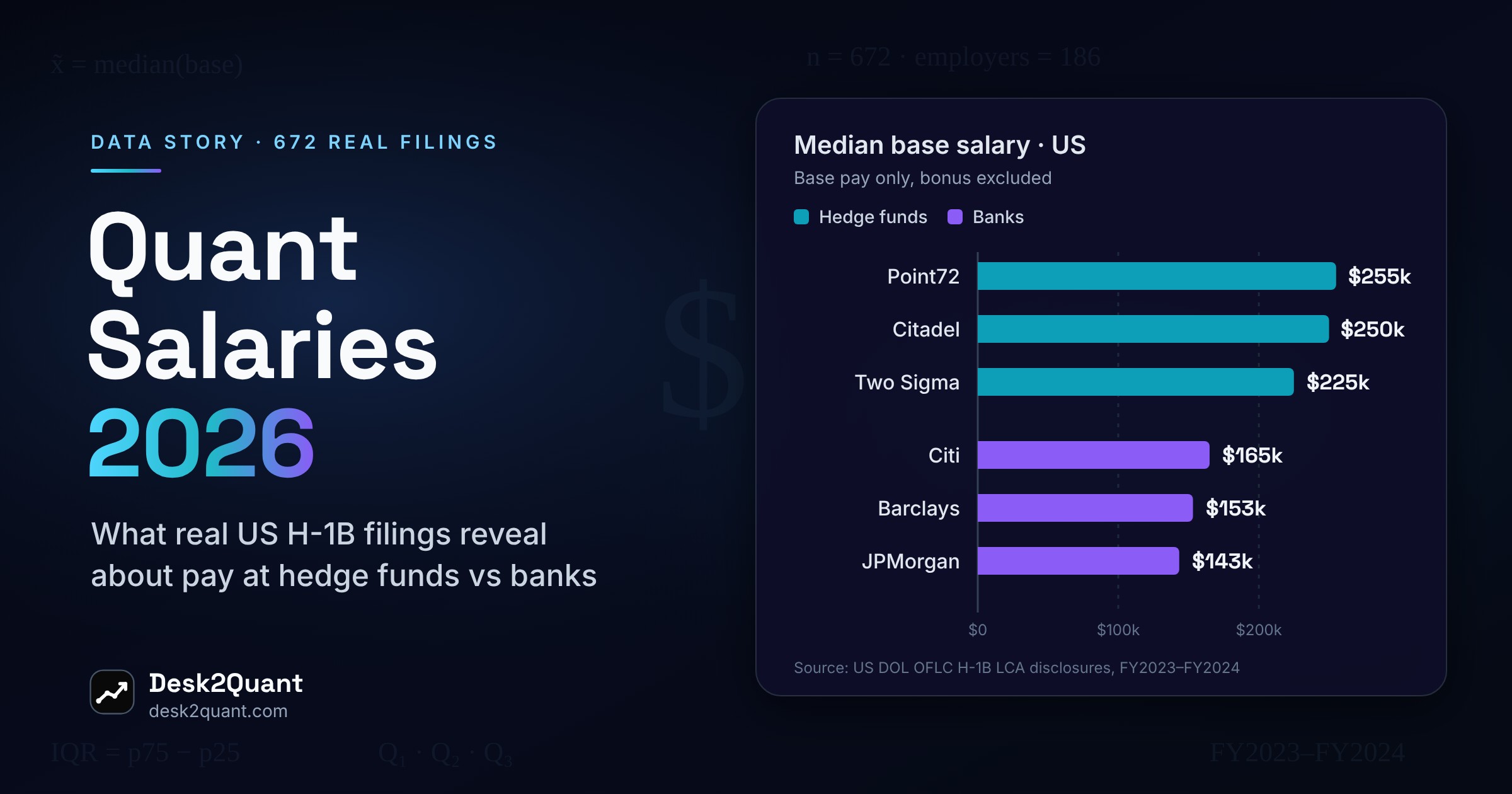
Quant base salaries from 672 real US H-1B filings across 186 firms: medians by role, seniority and employer, and the funds-vs-banks split beginners are never told.
October 6, 2026
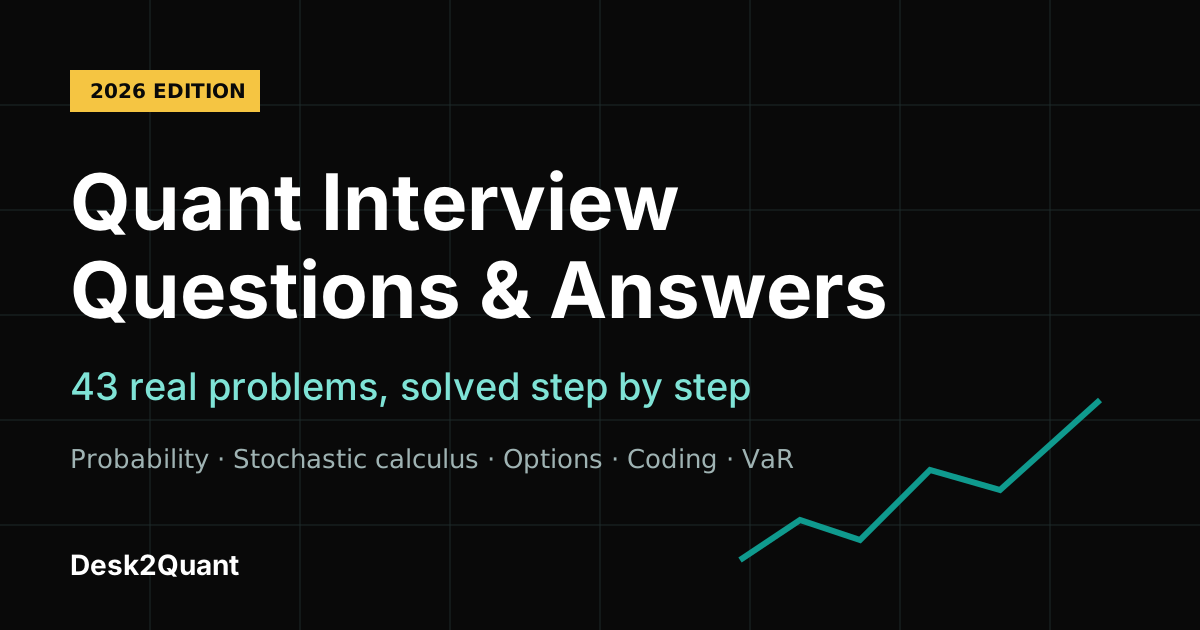
43 real quant interview questions with worked solutions across probability, statistics, stochastic calculus, options, coding and market risk, plus a 15-result cheat sheet.
October 1, 2026
FRTB standardised vs internal models approach explained: SBM, DRC, ES, PLA and RFET, and why IMA can cost more capital than SA. Worked on a five-desk book.
October 1, 2026
How VaR backtesting really works: Basel traffic-light zones, FRTB desk limits, Kupiec and Christoffersen tests, and what 4,919 days of real data revealed.
October 1, 2026
VaR vs Expected Shortfall explained for market-risk quants: what each measures, why FRTB switched to 97.5% ES, and why VaR backtesting still matters.
September 27, 2026
A practical roadmap for learning quantitative finance from scratch: the five building blocks, a 12-week plan, common mistakes and the best books.
September 27, 2026
What a desk quant does day to day, how the role differs from other quant jobs, the skills that matter, what drives pay, and how to become one.
September 26, 2026
Why Newton-Raphson implied volatility solvers blow up on wing options, and how to write a robust Python IV solver that works for any arbitrage-free price.
September 19, 2026
A production-style reconciliation framework for QuantLib vs Bloomberg pricing mismatches: conventions, curves, fixings, interpolation, cashflows, and numerics.
August 28, 2026
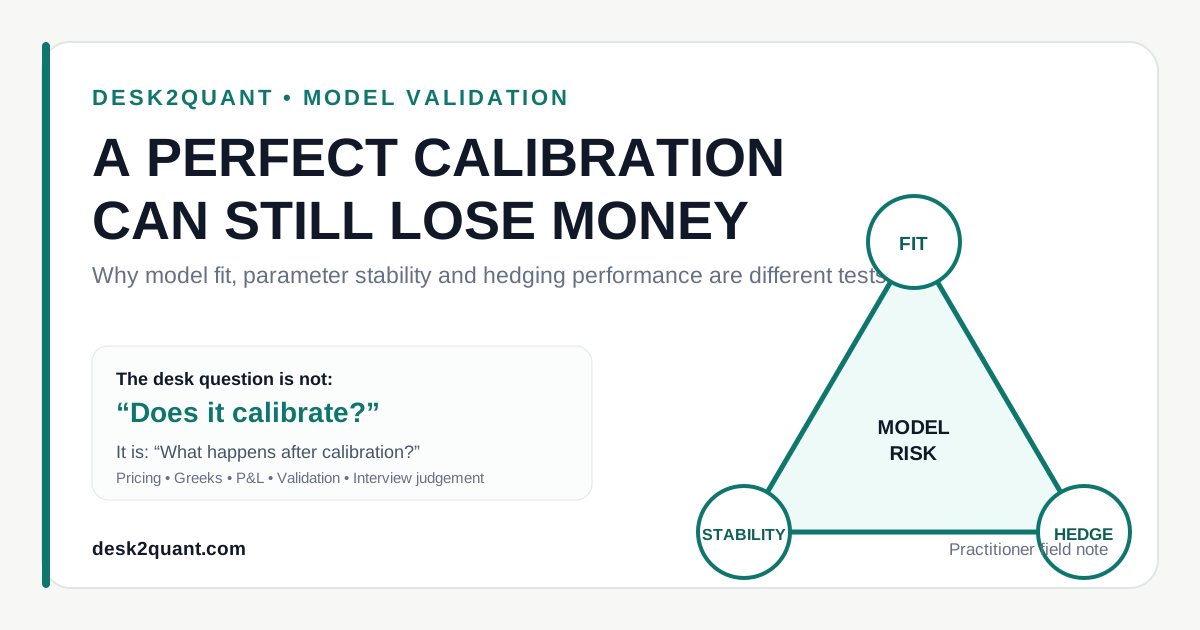
A model can fit every liquid market quote and still be dangerous in production. A practitioner framework separating calibration fit, parameter stability, and hedging/P&L performance.
August 2, 2026
The theory got you through the interview. Here is what actually happens in months one to three on a real desk — tracing numbers nobody documented, learning PnL explain, and defending your model under pressure.
July 28, 2026
What XVA stands for, what CVA, DVA, FVA, MVA and KVA each price in, and why banks charge them. XVA explained the way a desk quant would explain it.
July 27, 2026
Quant interview panels rarely fail candidates on missing knowledge. They fail them on instinct: reciting formulas without reasoning, skipping sanity checks, freezing under uncertainty. Here are the seven subtle tells that separate textbook candidates from desk-ready ones.
July 27, 2026
Delta, Gamma, Vega, Theta, Rho -- every candidate knows these. But real trading desks live and die by the second-order Greeks: Vanna, Volga, Charm, and Speed. Here is what they mean, why desks hedge them, and the exact interview questions that expose who actually understands them.
July 19, 2026
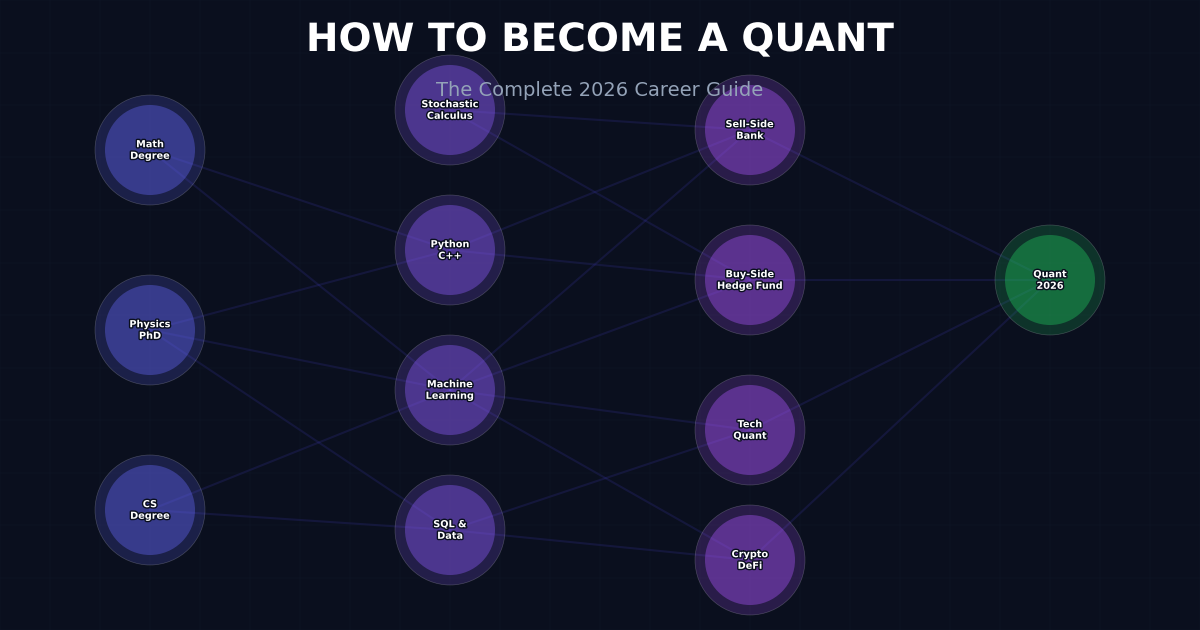
The definitive guide to breaking into quantitative finance in 2026. Covers career paths (sell-side, buy-side, quant dev, risk), skill stack (math, Python, C++, ML), interview process, salary data, AI impact, and a 90-day action plan. Updated with latest industry trends.
July 19, 2026
Master Monte Carlo simulation for option pricing from scratch. Covers GBM simulation, European and Asian option pricing, variance reduction techniques (antithetic variates, control variates), and Greeks estimation with runnable Python code and mathematical derivations.
March 5, 2026
Every derivatives trader knows that Black-Scholes is wrong. Not approximately wrong—structurally wrong. The model assumes constant volatility, yet every options market on earth shows a volatility smil...
February 17, 2026
In an era where GPT-4 and generative models are conquering coding, copywriting, and even legal analysis, a looming question persists: Will AI replace ...
Stay Updated
New articles published weekly. Follow me on LinkedIn for the latest updates.
Follow on LinkedIn